 Oct 20, 2026
 0 Comments

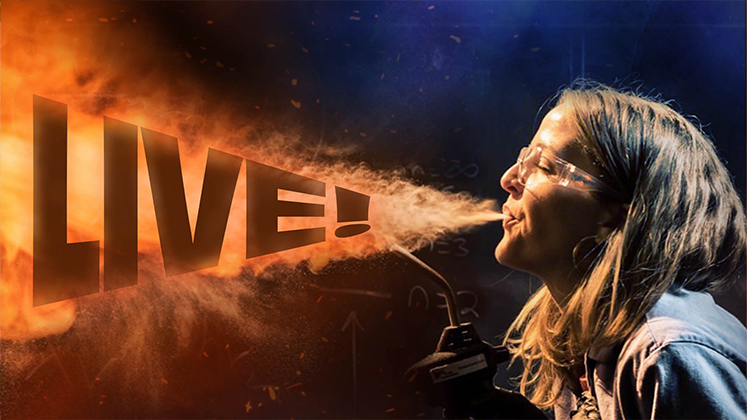
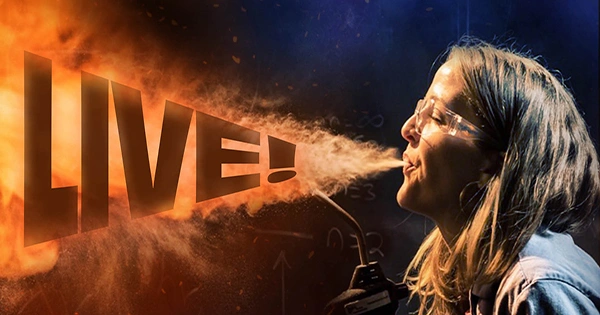
If you have ever seen liquid nitrogen turn a banana into a functioning hammer, or watched a room erupt in cheers over a wall of fire, you have likely witnessed the work of Dr. Kate Biberdorf. Globally recognized as Kate the Chemist, this dynamic scientist has traded the traditional, hushed atmosphere of the laboratory for a stage built on roaring, multi-sensory experiments.
Biberdorf is on a loud, colorful mission to prove that science is not just an academic chore—it is an art form. As the first Professor for the Public Understanding of Science at Notre Dame, Dr. Biberdorf uses fire, ice and explosions to highlight, amplify, teach and entertain audiences of all ages, and her theatrical hands-on approach to teaching through entertainment is breaking down the stereotypical image of a scientist and her skills will be on full display when she appears in the Auditorium at Midland Center for the Arts on Thursday, November 12th at 6:30 PM with tickets starting at only $25.00.
As the author of the bestseller The Big Book of Experiments, The Awesome Book of Edible Experiments for Kids, the fiction series Kate the Chemist, and the nonfiction book It's Elemental: The Hidden Chemistry in Everything, she has been profiled in the Washington Post, the Wall Street Journal, and The New York Times, and appeared on The Today Show, The Kelly Clarkson Show, NBC Nightly News, and Late Night with Stephen Colbert to name but a few.
With her latest show, Its Elemental, glow sticks fly, fireballs roar and foam erupts in this live science show built on the building blocks of everything: the elements. Kate the Chemist takes the audience on a high-energy tour of the periodic table, firing confetti cannons, launching paint can lids, turning flames into rainbows and finishing with a giant burst of elephant's toothpaste. Volunteers join Kate on stage, and every explosion comes with the science behind it. Kids and adults will leave seeing chemistry everywhere.
Recently The REVIEW had an opportunity to chat with Kate about her approach to teaching science along with the legacy and challenges of her unique mission.
REVIEW: You were appointed as the Inaugural Professor for Public Understanding of Science at the University of Notre Dame and am curious as to what exactly that role entails and how are using it to change the way the public interacts with academia?
Dr. KATE: That’s such a good question. Luckily, I have role models because this role exists in the UK and in lots of places elsewhere in the world, and it was started in 1995 at Oxford and physicist Richard Dawkins held the real first inaugural role, so I've had some great role models to be able to use as kind of a template to see what they do and how I can adapt what they did in the UK and bring it over here to the USA.
Here I am kind of like an Ambassador of Science, so I get to do wonderful things where I train our faculty on science communication and teach them how to approach the general public and how to think about the audience and how to figure out how we fit into their space. There are different models of this but basically, it's trying to bring people in to have quality conversations instead of talking at people. We do these trainings and talk about the best way to approach the public when you want to talk about your science.
But then on the opposite side of it, I really enjoy working with non-scientists as well. And one of my favorite partnerships right now is working with Ted, like the TED Talks group. Over the 18-months I've trained over 250 influencers on climate change. The idea is to sneak little climate friendly solutions into their content without like calling it out and being on the nose about it so they are still able to talk about it a way that's accurate, so I get to do these different types of projects where we're just helping the public understand science.
REVIEW: That's actually a good segue for my next question, because I know you started your career in lecture halls kind of building a huge profile, so I’m curious at what moment did you realize that theatrical explosive demonstrations were a really great way to bridge that gap between the expertise of science and public trust?
Dr. KATE: Honestly, it was right away. I taught the 8 AM class. If you've ever had an 8 AM science class that can be tough, so I definitely feel for the students that were there because of the hoops that they had to jump through and not necessarily because they wanted to pursue chemistry. I found if I wanted to connect with them and if I wanted them to stay awake and be engaged that demonstrations were an easy tool to use. And it also helps.
One tool is William James's theory of emotional memory, which basically says if you have an emotional response to something, you're more likely to remember it. If I set my hand on fire and I'm giggling, my students are like, “Wait, what's going on here? And that's my opportunity to teach X, Y, and Z whatever they will then need to know for work or something, so there's a reason behind the lesson. It's also very fun and a way to keep a 75- minute lecture upbeat when you're talking to an 18-year-old student.
REVIEW: You’ve performed in front of some pretty huge audiences on major network TV shows. What is the logistical nightmare of bringing explosive chemical reactions onto a major television set that's got a live audience?
Dr. KATE: Surprisingly, I get this question a lot. Because I'm a scientist. I do experiments repeatedly until I find what I consider to be the right way to do it. I like to bring my own equipment, the stuff that I trusted, the things I've tested, and I like to bring as much of that as possible, but there are restrictions. I'm not going to be flying with a jar of acid. I don't fly with dry ice. Some things are huge and bulky, and so we must get those on location too, like giant bottles that you're going to blow up. You need trash cans and you need to get all that on site. Then it depends on how big the explosion is.
I did one in LA for this show called The Talk, which unfortunately is no longer. I had so much fun with that group. They were always up for big explosions, but we had special effects people there. I mean, multiple people there to help us make sure it was safe. I’m setting up the chemistry side of things, making sure it's ready to go. They set up the detonation side because that's their expertise. We all do our best with our strengths, and we stay in our lane, which I think is nice, because then they also have the prop master’s that come in and they take my boring science equipment and they make it look beautiful because they know how to portray the artsy side of it.
It’s a case of many moving pieces and a lot of professionals that make me look good. I'm just lucky to be the chemist who is more like the ringleader.
REVIEW: Your first major non-fiction book It’s Elemental was your fist major work targeted explicitly for adults. What motivated you to pivot from writing children’s books to target an older audience and what was the hardest part about adjusting your tone for that?
Dr. KATE: I honestly think it was one of the hardest things I've ever done. My first version read more like a general chemistry textbook and my editor called me and said, ‘These books already exist and that’s not what we’re looking for here’, so we had tons of conversations about how to rework it, and I’m happy with how we ended breaking it up.
I found a way to talk about my favorite parts of science starting from having a morning breakfast and then a morning workout and then going all the way down to a date night at the end of the day and was able to sneak in the science encountered throughout the day.
It was very strategic and I had to figure out what types of chemistry to teach first and what to talk about having breakfast versus later at date night where I can talk about more complex things that we've built up to. It was a fun puzzle, but it was hard.
REVIEW: What is one routine or object that people use constantly that has the most surprising or complex chemistry behind it?
Dr. Kate: I think it's cleaning. I have a whole chapter on cleaning, which my editor was dubious about; but everything you're doing when you're cleaning is using some kind of chemical reaction. You're breaking down molecules, you're rearranging atoms and it's in a positive way. You're able to get something dirty or gross off your kitchen counter or the toilet and usually use a very strong acid to accomplish that. But that's why you don't mix these chemicals because you could do something that you do not want to actually do and release a bad gas or something.
A more friendly version your audience probably wants to hear about would be cooking. Anytime you're in the kitchen, you're constantly cooking. You're doing other chemical reactions, like caramelizing onions, or browning sugar - all of that is chemistry, and then you get to eat it, which I don't usually get to eat my chemical reaction. I feel like that's a quite a bonus.
REVIEW: Another major theme in that book is showing the hidden science that exists all around us. How do you think the understanding of the chemistry of ordinary things changes someone's perspective and views on life?
Dr. KATE: I think it gives you an understanding of everything around you. For me, the more I know about single use plastic, the more I can't handle it. If you know the chemistry about how hard it is to break down plastic and how it ends up sticking in landfills, when you learn about this, I think it's easier to change your actions to do things that are more climate friendly. If you understand the world around you, you can make better decisions and more environmentally friendly decisions because I care about the environment so much. It seems to be at the top of my mind today.
REVIEW: A more serious question relates to the proliferation of airborne chemicals and aluminum in the air particulates that emanate from geoengineering. How do you think we address that?
Dr. KATE: Even if we take a step back from that and look at wildfire pollution from the Canadian wildfires. We got hit with that down in Indiana, as you also did up in Michigan, and it was so intense I grabbed my mask out immediately because I know what you’re breathing in and putting in your lungs. I know after those fires, I personally got a big air filter for my house because I could breathe in that smoke while I was inside my home and I didn't like that. I didn't like how it smelled, and I knew it wasn’t healthy. That is a very problematic issue.
REVIEW: Let’s hit a couple fun wrap-up questions. You are well known for your signature liquid nitrogen ‘Thundercloud’ experiment. If you could pull off any dream experiment with zero budget or safety constraints, what would it be?
Dr. KATE: I think it would lean into the theatrical side, so I would want to have three or four versions of me or other people who are also pyromaniacs to pull it off, but I would want my own version of the Blue Man Group performing science experiments.
We would have song going on with booms and flashes all synced to the beat and the energy is up and the kids are screaming and we’re singing and the whole thing is like a big party only through the lens of science. It would be like Vegas science; however, you want to think of it.
I don’t know if I’d ever be able to pull it off, especially because the fire marshals in Las Vegas are the strictest I’ve ever met. But I would love to do that someday. That is the dream.
REVIEW: What is the biggest misconception you feel people have about modern chemistry and chemicals?
Dr. KATE: I believe most people think we are these nerdy people who hide in labs and don’t every see the sun, but I think modern chemists are inquisitive and they are fun. I think they are driven by questions and seeking answers and their main goal is to try to make this planet better for our next generation, whether that’s clean air, clean water, healthy medicines, or easier to access medicines. I think modern chemists are the modern-day superheroes. People will push back on that, but I stand behind it.
For more information and to purchase tickets for Kate the Chemist LIVE please click this link.
 info@review-mag.com
 989-780-4162











Comments (0)